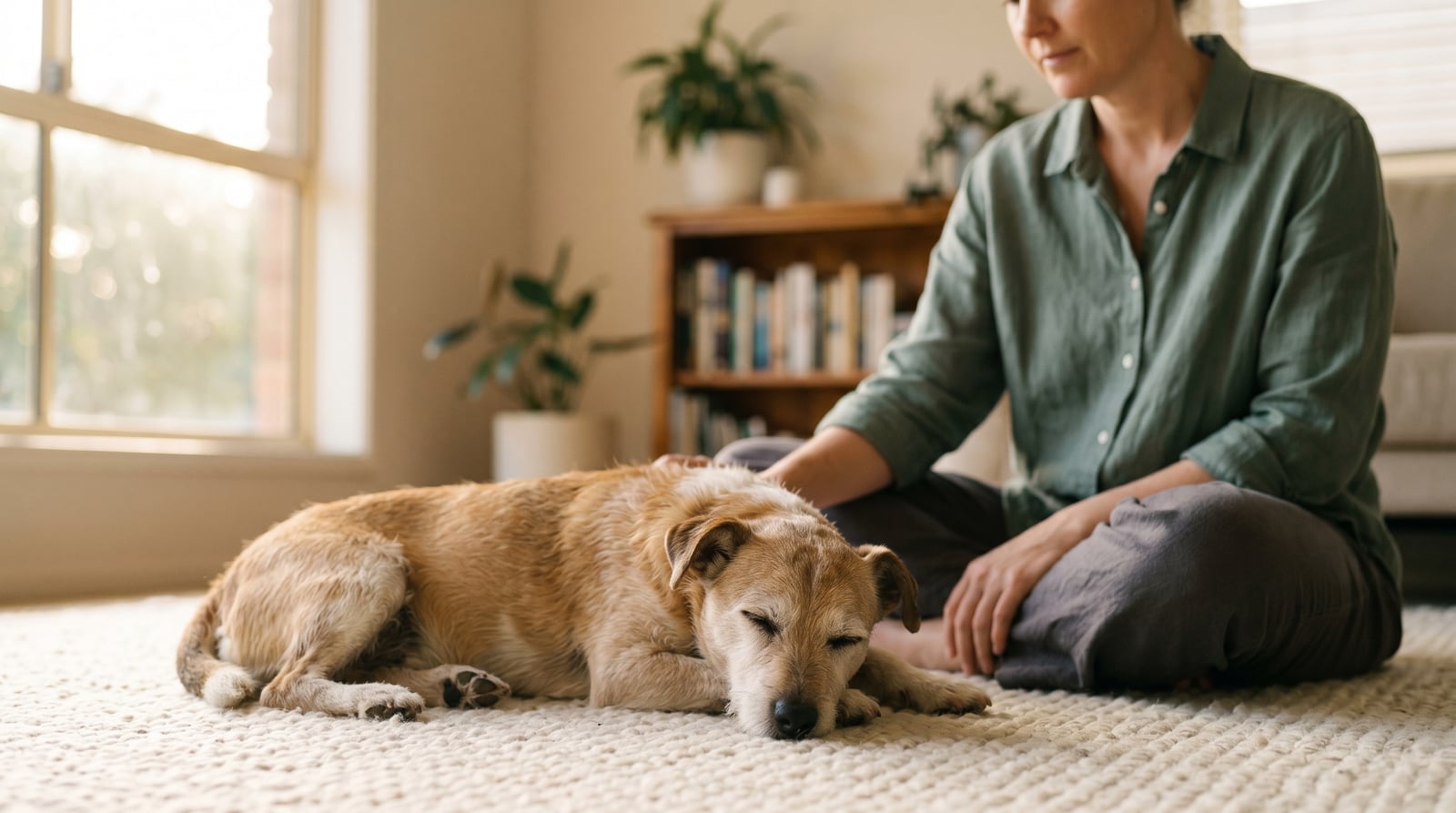
In short: Knowing when it's time to say goodbye to a pet is deeply personal, and your own vet is the right person to assess your pet's medical quality of life. Families often weigh whether their pet still enjoys food, comfort and the things they love, and whether good days now outnumber bad ones. If you're unsure, a gentle conversation with your vet about quality of life can bring clarity and peace.
There is no harder question than this
Few decisions ask more of a loving pet owner than knowing when to say goodbye to a pet. If you have found your way to these words, you are likely sitting with a heavy heart, watching a companion who has shared your life slow down, and wondering whether you are reading the signs rightly. Please know first of all that there are no easy answers here, and that the very fact you are agonising over this is a measure of how deeply you love them.
This is a gentle guide, not a checklist or a set of instructions. Every pet is different, every family is different, and the kindest, most accurate assessment of your pet's medical situation will always come from your own vet, who knows your pet and can examine them properly. What we hope to offer here is a little comfort and companionship as you navigate one of the hardest passages of pet ownership.
Quality of life, and what families often notice
When people talk about knowing when it's time, they are often really talking about pet quality of life — whether the good days still outnumber the hard ones, and whether your pet still finds comfort and joy in the small things that have always been theirs. These are not measurements anyone can hand you on a card. They are things you, who know your pet better than anyone, gradually come to sense.
Many families tell us they begin to notice gentle shifts over time. These are not diagnostic signs, and they don't apply to every pet, but they are the kinds of changes loved ones often reflect on:
- A fading interest in food, favourite treats, or the routines they once loved
- Difficulty getting comfortable, moving around, or resting through the night
- Less enthusiasm for greetings, play, or the company of the family
- More days that seem to be a struggle than days that seem content
- A sense, hard to put into words, that your pet no longer seems quite themselves
If you are noticing changes like these, the most loving next step is usually a conversation with your vet. They can assess what is happening medically, talk you through your pet's comfort and pain, and help you understand the options. The decision itself remains deeply personal and entirely yours, but you do not have to weigh it alone or in the dark.
When to say goodbye to a pet: gentle ways to reflect
Because there is no single moment that announces itself clearly, many families find it helps to find quiet ways of reflecting over time, rather than searching for one defining sign. Some people keep a simple note of the good days and the harder ones, not as a test to be passed, but as a gentle way of seeing a pattern they might otherwise miss in the day-to-day. Looking back over a week or two can sometimes reveal what is difficult to judge in any single afternoon.
Others find it helpful to think about the handful of things their pet has always loved most — a particular walk, a sunny spot, a favourite person, the simple pleasure of a meal. When those small joys begin to slip away, and comfort becomes harder to find than to lose, it can be a tender signal worth sharing with your vet. None of this is a formula, and none of it replaces professional guidance. It is simply a way of listening closely to a companion who cannot tell you in words.
It can also help to talk things through with the people who love your pet alongside you. Sometimes a partner, a grown child, or a close friend will notice something you have been too close to see, or will gently confirm what you already feel in your heart. You do not have to carry these observations alone.
The decision is yours, and it is personal
There is a reason no one can tell you exactly when the right moment has come. Saying goodbye to a pet is one of the most personal things a person ever does, shaped by your pet's particular condition, your family's circumstances, and a kind of quiet knowing that only you carry. Some families feel they would rather act a little early, to spare any suffering. Others wish to be certain, and hold on a while longer. Neither is wrong.
What matters is that the choice is made with love, with your vet's medical guidance, and at a pace that feels right to you. If you find yourself swinging between certainty and doubt, that is not a failing. It is simply what it feels like to love someone and not want to let them go.
Letting your vet lead on the medical questions
While the timing belongs to you and your family, the medical picture belongs with your vet. They are the right person to assess your pet's pain, comfort, and prognosis, to explain what to expect, and to answer the questions that keep you awake. Bring those questions to them, even the ones that feel too painful to ask aloud. A compassionate vet will hold that conversation gently and honestly.
If euthanasia is the path you and your vet choose, it can help to understand what comes afterwards before the day arrives, so that nothing feels rushed in a moment when you would rather be fully present with your pet. Our guide to pet cremation after euthanasia explains how gentle aftercare works, including collection from your home or vet clinic, so that the practical details are quietly taken care of. If you would like to read more about that process in plain language, our article on how pet cremation after euthanasia works in Adelaide walks through it step by step.
Caring for yourself through the goodbye
In the days surrounding such a decision, it is easy to pour everything into your pet and forget that you are grieving too. Anticipatory grief, the sorrow that arrives before the loss itself, is real and exhausting. Be as gentle with yourself as you are being with your companion. Let yourself feel what you feel, lean on people who understand, and try to rest when you can.
Guilt is one of the most common feelings families carry, particularly the quiet worry of whether they chose the right moment. If that weight settles on you, please be kind to yourself. Choosing to spare a beloved companion further suffering is among the most selfless acts of love a person can offer. Our reflections on coping with the loss of a pet may bring some comfort as you move through grief in your own time.
Supporting the whole family, including children
When a family pet nears the end of their life, the sorrow is rarely felt by one person alone. Children, in particular, may sense that something is changing long before anything is said, and they often take their cues from how the adults around them respond. Being gently honest with them, in words that suit their age, tends to help far more than trying to shield them entirely from the loss.
If you have little ones at home who are part of this goodbye, our guide on helping children cope with pet loss offers gentle, practical ways to talk with them and to include them in saying farewell. Allowing children a small part in the goodbye, whether a quiet cuddle or a drawn picture, can help them feel less powerless and gives their love somewhere to go.
Preparing gently for what comes next
When you are ready, and only then, it can ease the heart to know the practical care of your pet will be handled with dignity and warmth. Many families find it helps to think a little ahead, so the day of farewell can be spent simply being together. If your pet passes at home rather than at the clinic, our guide on what to do when your pet dies at home in Adelaide walks you gently through those first steps.
As a family-owned and locally operated service, we care for pets across metropolitan Adelaide, the Adelaide Hills and the surrounding regions of South Australia, with gentle collection from your home or your vet, ashes returned, and a paw-print keepsake to hold onto. There is never any hurry, and never any pressure.
Some families find a quiet comfort in thinking about how they would like to remember their companion afterwards, even before the day comes. Others would rather not, and that is entirely understandable. There is no need to make any of these decisions now. They can wait until your heart is ready, and we will be here whenever that is.
Making the most of your remaining time together
When you sense that your time together is drawing to a close, the days that remain can take on a quiet preciousness. Many families find comfort in gently shaping this time around the small things their pet still enjoys, rather than around what has been lost. There is no pressure to create grand farewells. Often it is the ordinary moments that mean the most.
Things that families have found tender and comforting in their pet's final days include:
- Spending unhurried time simply being together, with no agenda but closeness.
- Offering favourite foods or treats, where your vet says it is appropriate.
- Returning, if you can, to a much-loved place, even just a sunny patch of garden.
- Taking a few photographs or a paw print to keep, as a gentle memento.
- Letting every member of the family, including children, have their own quiet goodbye.
These small acts are not about doing things perfectly. They are simply ways of saying, in the language of presence rather than words, how deeply this companion has been loved.
You don't have to face this alone
Whatever stage you are at, whether you are quietly wondering or facing a decision that feels imminent, please know that support is here. Our pet loss support page offers further gentle guidance and resources for grieving families. And if you would simply like a calm, compassionate voice to talk things through with, you are always welcome to contact us. We will never rush you, and we will always meet you with kindness.